
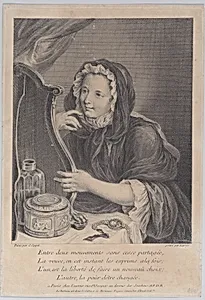
The Coquettish Widow
Medium
Etching and engraving
Dimensions
Plate: 10 7/16 × 7 1/8 in. (26.5 × 18.1 cm) Sheet: 10 5/8 × 7 5/16 in. (27 × 18.6 cm)
Classification
Prints
Department
Drawings and Prints
Museum
Metropolitan Museum of Art, New York, NY
Credit
Gift of Georgiana W. Sargent, in memory of John Osborne Sargent, 1924
Accession Number
24.63.1265
Rights
Public Domain
Tags
Art Historical Context
Created in 1724, *The Coquettish Widow* is a fine example of early eighteenth-century French printmaking. Designed by painter Charles Antoine Coypel and executed in etching and engraving by Bernard Lepicié with Louis Surugue, the work translates a painted composition into a reproducible format that allowed wider audiences to enjoy contemporary imagery. The medium’s combination of etched lines and engraved detail produces crisp textures and subtle shading, especially evident in the reflective surfaces and delicate fabrics. The subject centers on a widow whose playful demeanor challenges the expected solemnity of mourning. A mirror, prominently featured in the composition, underscores themes of vanity and self-presentation, inviting viewers to consider the social expectations placed on women of the period. Such lighthearted, gently satirical scenes were popular in Parisian circles, reflecting the era’s interest in wit and human foibles. Today housed in the Metropolitan Museum of Art’s Department of Drawings and Prints, this impression entered the collection as a gift in 1924. It remains a vivid reminder of how prints once circulated ideas about fashion, gender, and manners across Europe.
About the Artist
Bernard Lepicié|Charles Antoine Coypel|Louis Surugue (French|French|French) · 1699 |1698 |1698 –1779 |1755 |1755
French, Paris 1699–1779 Paris|French, Paris 1698–1755 Paris|French, Paris 1698–1755 Paris