
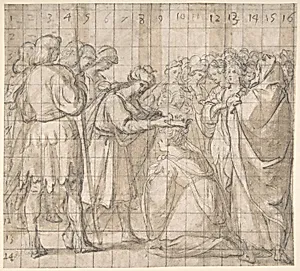
The Cornation of Esther by Ahasuerus
1560–1638
Medium
Black chalk and brown wash. Squared for transfer and numbered in black chalk
Dimensions
7-1/2 x 8-1/4 in. (19.0 x 21 cm)
Classification
Drawings
Department
Drawings and Prints
Museum
Metropolitan Museum of Art, New York, NY
Credit
Bequest of Harry G. Sperling, 1971
Accession Number
1975.131.208
Rights
Public Domain
Tags
Art Historical Context
In the intricate drawing *The Coronation of Esther by Ahasuerus*, attributed to Bartolomé or Vicente Carducho (active 1560–1638), we witness a pivotal biblical moment from the Book of Esther. The Persian king Ahasuerus crowns his queen Esther amid a gathering of men and women, symbolized by ornate crowns and regal attire. Created in black chalk and brown wash on a modest 7-1/2 x 8-1/4 inch sheet, this preparatory study reveals the artists' meticulous planning: it's squared for transfer to a larger canvas or fresco and numbered, likely as part of a narrative series. The Carducho brothers, Italian-born painters who thrived in Spain during the late Renaissance and early Baroque, excelled in Mannerist style—characterized by elegant figures, dynamic compositions, and dramatic lighting. This technique allowed for fluid sketches that captured emotional intensity, bridging drawing and grand painting. Such biblical scenes were culturally vital in Counter-Reformation Europe, reinforcing faith through visual storytelling in palaces and churches. Housed in the Metropolitan Museum of Art's Drawings and Prints department (Bequest of Harry G. Sperling, 1971), this work offers a rare glimpse into the creative process behind opulent Spanish religious art, inviting visitors to appreciate the humble origins of majestic masterpieces.
About the Artist
Bartolomé Carducho|Vicente Carducho (Spanish|Italian) · 1560 |1570 –1608 |1638
Spanish, Florence ca. 1560–1608 Madrid|Italian, 1570/78–1638