
The Counterfeiters
1843
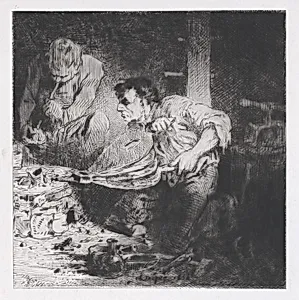
Medium
Drypoint
Dimensions
Sheet: 9 1/16 × 8 1/4 in. (23 × 21 cm) Plate: 7 1/2 × 7 1/16 in. (19 × 18 cm)
Classification
Prints
Department
Drawings and Prints
Museum
Metropolitan Museum of Art, New York, NY
Credit
Elisha Whittelsey Fund, 1963
Accession Number
63.625.420
Rights
Public Domain
Tags
Art Historical Context
**The Counterfeiters** (1843) is a striking drypoint print by French artist Charles Jacque, capturing a tense scene of illicit activity. Jacque, a member of the Barbizon School known for his rustic landscapes and animal studies, here turns to a more dramatic narrative, depicting men huddled around bellows—likely stoking a forge to craft fake coins. Created during France's July Monarchy, a period of economic strain and social upheaval, the work subtly evokes the era's underbelly of crime and desperation, blending realism with a touch of moral intrigue. Drypoint, Jacque's chosen medium, showcases his mastery of intaglio printing. By scratching directly into a copper plate with a sharp needle, he produced the burr that yields the technique's signature soft, velvety lines and rich tonal depth—ideal for conveying the flickering light of a hidden workshop and the coarse textures of tools and figures. Measuring just 7½ × 7¹⁄₁₆ inches on the plate, this intimate print invites close viewing, highlighting Jacque's precise linework and atmospheric effects. Housed in the Metropolitan Museum of Art's Drawings and Prints department (Elisha Whittelsey Fund, 1963), **The Counterfeiters** exemplifies 19th-century printmaking's role in exploring everyday vices. Its compact scale and evocative theme make it a gem for visitors pondering art's power to illuminate society's shadows.
About the Artist
Charles Jacque · 1813–1894
Charles-Émile Jacque (1813–1894) was a pioneering French painter, engraver, and illustrator whose career bridged the worlds of printmaking and pastoral painting. Born in Paris amid a difficult childhood, he apprenticed at age seventeen to a map engraver, mastering drypoint technique and producing his first etching in 1830—a copy of a head after Rembrandt. After serving seven years in the French Ar...