
The Country Store
Classification
Painting
Department
Smithsonian Collection
Museum
Smithsonian American Art Museum
Credit
Hirshhorn Museum and Sculpture Garden, Smithsonian Institution, Washington, DC, Gift of Joseph H. Hirshhorn, 1966
Accession Number
66.2490
Rights
Public Domain
About this artwork
Jh Purchased From Parke-bernet Galleries, New York 1964
Art Historical Context
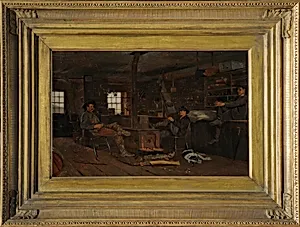
Winslow Homer, a pivotal American realist painter born in Boston in 1836, captured the essence of 19th-century rural America in *The Country Store* (1872). Created during the post-Civil Reconstruction era, this painting likely depicts everyday life in a small-town general store—a hub of community interaction amid America's shift from agrarian roots to industrialization. Homer, who began as a commercial illustrator before turning to fine art, drew from his keen observations of ordinary people, infusing his works with authenticity and vitality. Homer's style exemplifies American Realism, emphasizing natural light, candid figures, and unidealized scenes that contrasted with the romanticism of earlier movements like the Hudson River School. Though the medium is unspecified, his paintings often employed oil on canvas to achieve luminous effects and textured detail, highlighting human resilience and the American landscape. *The Country Store* reflects his growing fascination with rural narratives, a theme that defined his later Adirondacks and Maine periods. Acquired at the prestigious Parke-Bernet Galleries auction in New York in 1964 and gifted to the Hirshhorn Museum and Sculpture Garden by Joseph H. Hirshhorn in 1966, this piece now resides in the Smithsonian American Art Museum. It invites visitors to ponder the simple rhythms of 1870s America, preserved for generations.