
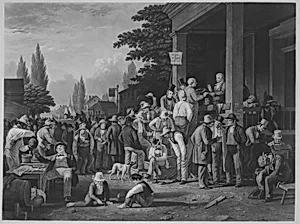
The County Election
Medium
Engraving; India proof before final letters
Dimensions
21-1/2 x 26-1/2 in. (54.6 x 67.3 cm)
Classification
Prints
Department
Drawings and Prints
Museum
Metropolitan Museum of Art, New York, NY
Credit
The Elisha Whittelsey Collection, The Elisha Whittelsey Fund, 1952
Accession Number
52.572
Rights
Public Domain
Tags
Art Historical Context
The County Election is a finely detailed engraving produced in 1847 after a composition by American genre painter George Caleb Bingham. Created as an India proof before final letters, the print a lively scene of men gathered outside a modest building to cast their votes, accompanied by children and dogs. Bingham’s original paintings celebrated everyday moments of frontier democracy, and this engraving extends that vision to a wider audience through the reproductive talents of engraver John Sartain and publishers Goupil & Co. In the mid-nineteenth century, such images offered viewers a vivid record of American political life during a period of rapid westward expansion. The composition balances orderly civic participation with informal social interactions, reflecting both the idealism and the rough-and-tumble realities of local elections. The large scale of the print—over two feet wide—allowed the work to function almost like a painting when framed, bringing the energy of a Missouri county courthouse into homes and public spaces across the country. As a reproductive print, the engraving played an important role in disseminating Bingham’s vision beyond the original canvas. Its meticulous line work preserves the textures of clothing, wooden architecture, and animated gestures, inviting modern viewers to consider how art helped shape popular understandings of citizenship and community in the young republic.