
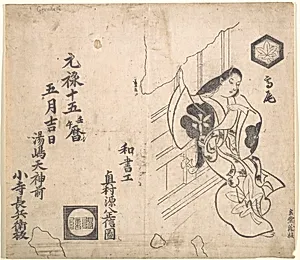
The Courtesan Takao Leaving Against a Window
Medium
Monochrome woodblock print; ink on paper
Dimensions
11 x 12 1/4 in. (27.9 x 31.1 cm)
Classification
Prints
Culture & Period
Japan · Edo period (1615–1868)
Department
Asian Art
Museum
Metropolitan Museum of Art, New York, NY
Credit
Bequest of Julia H. Manges, in memory of her husband, Dr. Morris Manges, 1960
Accession Number
JP3411
Rights
Public Domain
Tags
Art Historical Context
In the vibrant world of Edo-period Japan (1615–1868), Okumura Masobu captures a moment of elegant departure in *The Courtesan Tak Leaving Against a Window*. intimate monochrome woodblock print, in ink on paper, the renowned courtesan Takao— a celebrated beauty from the Yoshiwara pleasure district—poised dramatically against a window frame. Masanobu, an innovative ukiyo-e master in the early 18th century, was known for pushing the boundaries of printmaking, and this work exemplifies the "floating world" genre's focus on fleeting pleasures, fashion, and feminine allure. The monochrome technique, or *sumizuri-e*, highlights Masanobu's skillful use of subtle ink gradations to convey texture, light, and emotion without color, a precursor to the multicolored masterpieces that would define later ukiyo-e. Woodblock prints like this were affordable art for the rising merchant class, democratizing depictions of high-society courtesans who embodied wit, style, and transience. Measuring just 11 x 12¼ inches, it invites close viewing, revealing fine details in Takao's kimono folds and the window's lattice. Housed in the Metropolitan Museum of Art's Asian Art Department, this bequest from Julia H. Manges honors a slice of Japan's cultural golden age, where art celebrated the lives of women like Takao, whose legends inspired poetry and prints alike. A window into Edo's glamorous underbelly!
About the Artist
Okumura Masanobu · 1686–1764
Japanese, 1686–1764