
The Cravat
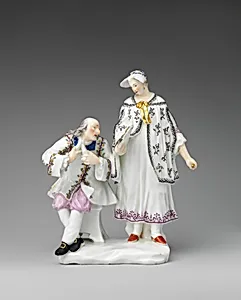
Medium
Soft-paste porcelain
Dimensions
Overall (confirmed): H. 8 7/16 x W. 6 7/8 x D. 4 1/8 in. (21.4 x 17.5 x 10.5 cm)
Classification
Ceramics-Porcelain
Culture
Italian, Naples
Department
European Sculpture and Decorative Arts
Museum
Metropolitan Museum of Art, New York, NY
Credit
Gift of Douglas Dillon, 1983
Accession Number
1983.488.4
Rights
Public Domain
Tags
Art Historical Context
"The Cravat" is a delightful soft-paste porcelain sculpture created around 1750–55 by Giuseppe Gricci at the renowned Capodimonte Porcelain Manufactory in Naples, Italy. Measuring about 8½ inches high, this intimate piece belongs to the European Rococo tradition, where porcelain artists crafted whimsical figures and groups for aristocratic homes. Gricci, a master modeller at Capodimonte, was celebrated for his lively depictions of everyday elegance, often infusing his works with theatrical flair reflective of Neapolitan culture. Soft-paste porcelain, the medium here, was a prized European innovation before hard-paste techniques dominated. Capodimonte's formula, developed under royal patronage of Charles VII of Naples (later Charles III of Spain), produced a creamy, translucent body ideal for intricate modeling. In "The Cravat," Gricci likely showcased meticulous details in clothing and accessories—like the titular cravat—highlighting the factory's prowess in capturing fabric folds, delicate lace, and expressive poses amid male and female figures. This gift to the Metropolitan Museum of Art from Douglas Dillon in 1983 exemplifies Capodimonte's brief but brilliant golden age (1743–1759), when it rivaled Meissen and Sèvres. A symbol of 18th-century luxury and Bourbon ambition, it invites visitors to appreciate the artistry of porcelain as sculpture, blending technical virtuosity with playful social commentary.
About the Artist
Giuseppe Gricci|Capodimonte Porcelain Manufactory (Italian|Italian) · 1695 |1740 –1775 |1759
Italian, ca. 1700–1770|Italian, 1740/43–1759