
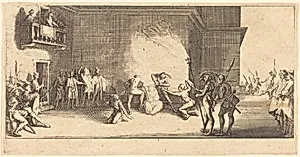
The Crowning with Thorns
c. 1618
Medium
etching and engraving on laid paper
Dimensions
sheet (trimmed to plate mark): 11 × 21.2 cm (4 5/16 × 8 3/8 in.)
Classification
Department
CG-E
Museum
National Gallery of Art, Washington, D.C.
Credit
Rosenwald Collection
Accession Number
1949.5.277
Rights
Public Domain
Art Historical Context
Jacques Callot's *The Crowning with Th* (c. 1618) captures a pivotal moment from the Passion of Christ, depicting the mocking of Jesus by Roman soldiers as described in the Gospels. Created during Callot's time in Florence under Medici patronage, this intimate print reflects the artist's mastery of Baroque drama, blending religious devotion with intricate narrative detail. At just 11 × 21.2 cm, its trimmed sheet invites close viewing, drawing visitors into the emotional intensity of the scene. Callot, a pioneering French printmaker, combined etching—where acid etches lines into a metal plate for fluid, expressive marks—with engraving's precise burin incisions for sharp definition. Printed on laid paper, typical of the era's fine art papers with visible chain lines, this technique allowed for extraordinary finesse in a small format. Callot's innovative use of multiple biting stages in etching produced rich tonal contrasts, making his prints highly sought after and reproducible, spreading religious imagery across Europe. Housed in the National Gallery of Art's Rosenwald Collection (Department CG-E), this work exemplifies Callot's influence on printmaking during the early 17th century, bridging Mannerism and Baroque. It not only served devotional purposes but also showcased technical virtuosity, reminding us how prints democratized art for wider audiences.
About the Artist
Jacques Callot · 1592–1635
Jacques Callot (1592–1635) was a French printmaker and draftsman from the Duchy of Lorraine, widely regarded as one of the first great artists to practice the graphic arts exclusively. His more than 1,400 etchings chronicled the breadth of 17th-century life, from Medici court festivities to the brutal realities of warfare. Callot revolutionized etching through technical innovations including the é...