
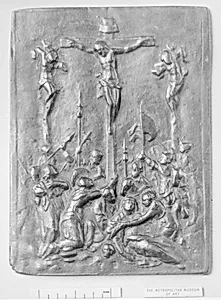
The Crucifixion
Unknown Artist
16th century
Medium
Bronze
Dimensions
3 3/4 × 2 3/4 in. (9.5 × 7 cm)
Classification
Medals and Plaquettes
Culture
German, Augsburg
Department
European Sculpture and Decorative Arts
Museum
Metropolitan Museum of Art, New York, NY
Credit
Rogers Fund, 1912
Accession Number
12.140.3
Rights
Public Domain
Tags
Art Historical Context
In the heart of 16th-century Augsburg, a thriving German center for metalworking during the Renaissance, this small bronze plaquette captures the poignant drama of *The Crucifixion*. Depicting Jesus on the cross amid the sorrowful scene of his Passion, the unknown artist's work exemplifies the era's devotional art, where intimate, portable objects like medals and plaquettes served as aids to prayer or cherished collectibles for the devout and elite alike. Crafted in bronze—a durable medium prized for its rich patina and fine detail—this relief measures just 3 3/4 × 2 3/4 inches, perfect for wearing as a pendant or displaying in a cabinet of curiosities. Augsburg's skilled goldsmiths and casters, influenced by Italian Renaissance techniques like lost-wax casting, produced such pieces with exquisite precision, blending Northern Gothic piety with emerging humanism. Acquired through the Rogers Fund in 1912, it now graces the Metropolitan Museum of Art's European Sculpture and Decorative Arts collection. This humble yet powerful artifact invites reflection on faith's enduring role in daily life, reminding us how Renaissance artisans transformed profound theology into tangible, touchable beauty. A testament to Augsburg's artistic legacy, it whispers of a time when spirituality fit in the palm of your hand.