
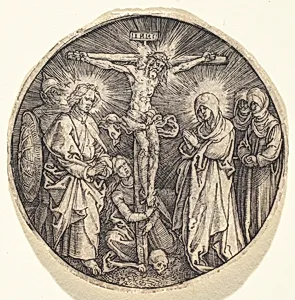
The Crucifixion called the Sword Pommel of Maximilian
c. 1518
Medium
engraving on laid paper
Dimensions
sheet (diameter; trimmed to platemark): 3.81 cm (1 1/2 in.)
Classification
Department
CG-E
Museum
National Gallery of Art, Washington, D.C.
Credit
Rosenwald Collection
Accession Number
1943.3.3538
Rights
Public Domain
Art Historical Context
Behold *The Crucifixion called the Sword Pommel of Maximilian*, a exquisite engraving by Albrecht Dürer, the preeminent artist of the Northern Renaissance, created around 1518. This remarkably tiny work—measuring just 3.81 cm in diameter on laid paper—depicts the poignant scene of Christ's Crucifixion, with the Savior flanked by the Virgin Mary and Saint John the Evangelist. Its circular format and intimate scale suggest it was designed to adorn the pommel of a sword belonging to Holy Roman Emperor Maximilian I, a patron Dürer greatly admired and served. Dürer's mastery of engraving shines here, as he incised intricate details into a copper plate to produce sharp, tonal contrasts and lifelike expressions on such a minuscule surface. Engravings like this revolutionized art dissemination in the 16th century, allowing high-quality images to reach collectors far beyond paintings. This print exemplifies Dürer's technical virtuosity and his blend of Gothic precision with emerging Renaissance humanism. Housed in the National Gallery of Art's Rosenwald Collection, this gem highlights the era's fusion of faith, craftsmanship, and imperial prestige. Imagine it glinting on a noble's hilt—a profound reminder of devotion amid the clash of steel.
About the Artist
Albrecht Dürer · 1471–1528
Albrecht Dürer (1471–1528) stands as the preeminent figure of the Northern Renaissance and arguably the most influential artist in the history of printmaking. Born in Nuremberg on May 21, 1471, and dying in the same city on April 6, 1528, Dürer revolutionized the status of the artist in Northern Europe, transforming printmaking from a commercial craft into an independent fine art and establishing ...