
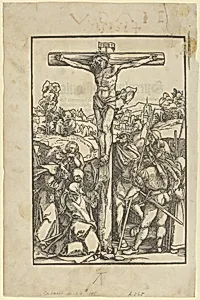
The Crucifixion, from Speculum passionis domini nostri Ihesu Christi
Medium
Woodcut
Dimensions
Sheet: 12 1/16 × 7 7/8 in. (30.6 × 20 cm)
Classification
Prints
Department
Drawings and Prints
Museum
Metropolitan Museum of Art, New York, NY
Credit
Gift of Harry G. Friedman, 1962
Accession Number
62.635.487
Rights
Public Domain
Tags
Art Historical Context
Behold *The Crucifixion*, a striking woodcut from 1507, created by German artist Hans Schäufelein in collaboration with Ulrich Pinder and Friedrich Peypus. This is part of the devotional book *Speculum passionis domini Ihesu Christi*Mirror of the Passion of Our Lord Jesus Christ"), a Northern Renaissance publication designed to guide viewers through Christ's suffering with vivid imagery. Measuring 12 1/16 × 7 7/8 inches, it captures the dramatic scene of Christ's crucifixion amid soldiers, men, and women, their expressions conveying profound sorrow and reverence. Woodcuts like this one were revolutionary for their time, enabling affordable mass production of religious art through relief printing on wood blocks. Schäufelein, a pupil of Albrecht Dürer, infused the composition with intricate details—flowing drapery, expressive faces, and dynamic poses—that reflect the emotional intensity of late Gothic and early Renaissance styles in Germany. These prints served as meditative tools for laypeople, fostering personal piety during an era of religious fervor just before the Protestant Reformation. Housed in the Metropolitan Museum of Art's Drawings and Prints department (gift of Harry G. Friedman, 1962), this work exemplifies how art bridged faith and accessibility, inviting viewers to contemplate the Passion in their homes or churches. Its enduring power lies in that intimate, unflinching gaze at human suffering and divine sacrifice.
About the Artist
Hans Schäufelein|Ulrich Pinder|Friedrich Peypus · 1480–1540
Hans Schäufelein (c. 1480–c. 1540) was a German painter and graphic artist of the Northern Renaissance whose career placed him at the heart of one of the most dynamic artistic environments in European history. As a young man, he entered the workshop of Albrecht Dürer in Nuremberg, an experience that proved decisive: Dürer's meticulous approach to draughtsmanship, his mastery of printmaking, and hi...