
The Crucifixion
c. 1631
Medium
etching on laid paper
Dimensions
sheet (trimmed to plate mark): 3.5 × 3.6 cm (1 3/8 × 1 7/16 in.)
Classification
Department
CG-E
Museum
National Gallery of Art, Washington, D.C.
Credit
R.L. Baumfeld Collection
Accession Number
1969.15.877
Rights
Public Domain
Art Historical Context
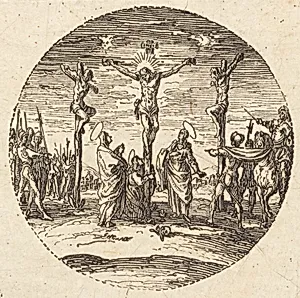
Jacques Callot's *The Crucifixion*, around 1631, captures the pivotal moment of Christ's sacrifice in a remarkably intimate scale—measuring just 3.5 × 3.6 cm on laid paper. As a master of French Baroque printmaking, Callot was renowned for his intricate etchings, often produced in series for devotional use. This tiny work, part of the National Gallery of Art's R.L. Baumfeld Collection, exemplifies "petit format" style, where minuscule details invite close contemplation, much like a personal prayer book illustration. Created during the Counter-Reformation era, amid the religious fervor of 17th-century Europe, the print reflects Baroque emphasis on emotional intensity and dramatic piety. Callot, who worked in Florence and Nancy, blended Northern precision with Italian grandeur, using etching's acid-bitten lines to render Christ's anguished form, the mourning figures at the cross's base, and a crowded heavenly host above. His innovative technique—employing multiple biting stages for varied line depths—achieved astonishing texture and depth in such a confined space. This etching not only showcases Callot's technical virtuosity, influencing later artists like Rembrandt, but also served as affordable religious art for the faithful, bridging elite patronage with popular devotion during turbulent times like the Thirty Years' War. A gem for print enthusiasts, it rewards magnification to reveal its narrative richness.
About the Artist
Jacques Callot · 1592–1635
Jacques Callot (1592–1635) was a French printmaker and draftsman from the Duchy of Lorraine, widely regarded as one of the first great artists to practice the graphic arts exclusively. His more than 1,400 etchings chronicled the breadth of 17th-century life, from Medici court festivities to the brutal realities of warfare. Callot revolutionized etching through technical innovations including the é...