
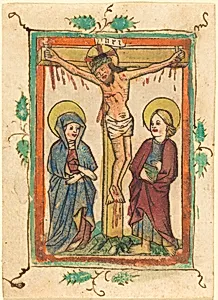
The Crucifixion
Medium
hand-colored engraving
Dimensions
sheet: 9.5 × 6.8 cm (3 3/4 × 2 11/16 in.)
Classification
Department
CG-E
Museum
National Gallery of Art, Washington, D.C.
Credit
Rosenwald Collection
Accession Number
1943.3.5783
Rights
Public Domain
Art Historical Context
Behold *The Crucifixion*, a delicate hand-colored engraving from around 1460 by the enigmatic Master of the Dutuit of Olives, an anonymous Netherlandish artist active in the mid-15th century. just 9.5 × 6.8 cm, this miniature print captures the pivotal Christian scene of Christ's death on the cross, rendered with intricate line work typical of early engraving techniques. Housed in the National Gallery of Art Rosenwald Collection, it the dawn of printmaking in Northern Europe, where metal plates allowed for detailed imagery that could be reproduced and personalized. Hand-coloring, applied by skilled artisans after printing, transformed this utilitarian medium into a vibrant, jewel-like devotional object. Washes of color brought emotional depth to the somber narrative, making it ideal for private prayer or portable piety during the late Gothic era. The Master's style echoes contemporaries like the Master of the Playing Cards, with fine hatching for shading and expressive figures that convey profound spirituality. This tiny treasure highlights a revolutionary shift: prints democratized art, bridging elite manuscripts and everyday faith. Visitors, imagine cradling it in your palm—a window into 15th-century devotion amid the Hundred Years' War's turmoil.