
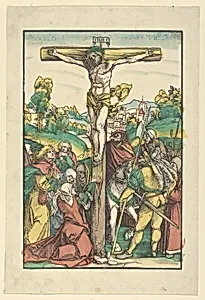
The Crucifixion (restrike?)
after 1505
Medium
Woodcut (hand-colored, possibly a later restrike)
Dimensions
Sheet: 11 3/16 × 7 9/16 in. (28.4 × 19.2 cm)
Classification
Prints
Department
Drawings and Prints
Museum
Metropolitan Museum of Art, New York, NY
Credit
Bequest of James Clark McGuire, 1930
Accession Number
31.54.104
Rights
Public Domain
Tags
Art Historical Context
Hans Schäufelein, a German artist of the Northern Renaissance, created *The Crucifixion* after 1505 as a woodcut print, a technique that revolutionized accessible art during the early 16th century. in the circle of Albrecht Dürer Schäufelein mastered intricate woodcuts, carving designs into wood blocks for inking and printing multiple impressions. This hand-colored example, measuring 11 3/16 × 7 9/16 inches, may be a later restrike reprint from the original block—preserving the work's dramatic depiction of Christ's crucifixion amid men and women, evoking profound religious devotion. Woodcuts like this were vital for spreading Christian iconography across Europe, especially in the lead-up to the Reformation, when printed images fueled personal piety and theological debate. The hand-coloring enhances the emotional intensity, with vibrant hues drawing viewers into the solemn scene of sacrifice and redemption. Housed in the Metropolitan Museum of Art's Drawings and Prints department through the 1930 bequest of James Clark McGuire, it exemplifies how Renaissance prints democratized high art, bridging workshops and households alike.
About the Artist
Hans Schäufelein · 1480–1540
Hans Schäufelein (c. 1480–c. 1540) was a German painter and graphic artist of the Northern Renaissance whose career placed him at the heart of one of the most dynamic artistic environments in European history. As a young man, he entered the workshop of Albrecht Dürer in Nuremberg, an experience that proved decisive: Dürer's meticulous approach to draughtsmanship, his mastery of printmaking, and hi...