
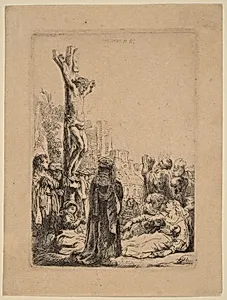
The Crucifixion: Small Plate
c. 1635
Medium
etching
Classification
Department
CG-E
Museum
National Gallery of Art, Washington, D.C.
Credit
Rosenwald Collection
Accession Number
1943.3.7252
Rights
Public Domain
Art Historical Context
In the hushed drama of Rembrandt van Rijn's *The Crucifixion: Plate* (c. 1635), we witness the Dutch master's profound engagement with one of Christianity's most poignant moments. Created during the height of the Dutch Golden Age, this etching Christ on the cross amid mourning figures, rendered with Rembrandt's signature chiaroscurodeep shadows contrasting luminous highlights to evoke raw emotion and spiritual depth. As a Baroque artist, Rembrandt infused religious subjects with human intimacy, drawing from his Protestant milieu where personal faith resonated deeply. Etching, Rembrandt's favored printmaking technique, allowed him unparalleled control: he bit acid into a copper plate to create delicate, velvety lines, producing editions that spread his genius affordably across Europe. This small plate (hence its name) exemplifies his innovative "open biting," yielding rich tonal variations that mimic oil painting's texture. Housed in the National Gallery of Art's Rosenwald Collection (Department CG-E), it stands as a testament to Rembrandt's printmaking prowess, blending technical virtuosity with empathetic storytelling. Visitors are drawn to its intimate scale—ideal for contemplation—revealing how 17th-century art bridged divine narrative and everyday devotion, influencing generations of printmakers.
About the Artist
Rembrandt van Rijn · 1606–1669
Rembrandt Harmenszoon van Rijn (1606–1669) stands as one of the greatest visual artists in the history of Western art and the most important Dutch painter of the 17th century. Born in Leiden to a prosperous miller's family, Rembrandt transformed painting through his revolutionary use of light and shadow, his psychological depth in portraiture, and his elevation of etching to a fine art. His approx...