
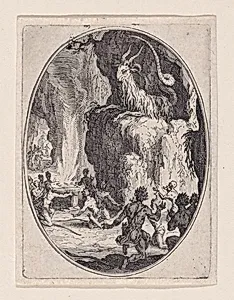
The Culte du Démon (The Cult of the Demon), from Les Sacrifices (The Sacrifices)
ca. 1625
Medium
Etching
Dimensions
Sheet: 2 3/4 x 2 1/8 in. (7 x 5.4 cm) Plate: 2 5/8 x 1 15/16 in. (6.6 x 5 cm)
Classification
Prints
Department
Drawings and Prints
Museum
Metropolitan Museum of Art, New York, NY
Credit
Bequest of Julie Parsons Redmond, 1960
Accession Number
60.534.7
Rights
Public Domain
About this artwork
This small but powerful etching exemplifies Jacques Callot's mastery of the intaglio printmaking process and his fascination with fantastical and macabre subjects. Created around 1625 as part of the series "Les Sacrifices" (The Sacrifices), "The Culte du Démon" presents a disturbing scene of demonic worship that reflects both Counter-Reformation concerns about witchcraft and Callot's own imaginative vision. Despite its diminutive size—the plate measures merely 6.6 by 5 centimeters—the etching co...
Art Historical Context
Jacques Callot's *The Culte du Dé (The Cult of the Demon)*, created around 1625 as part of his series *Les Sacrifices*, a chilling scene of demonic worship in a remarkably small etching—measuring just 6.6 by 5 cm on the plate. Working in the Duchy of Lorraine during a time of religious upheaval, Callot drew on Counter-Reformation anxieties about witchcraft, blending them with his own vivid imagination for the macabre. This print exemplifies his fascination with humanity's darker spiritual impulses, echoing themes in works like *The Temptation of St. Anthony* and *The Miseries of War*. What makes this etching extraordinary is Callot's technical genius in intaglio printmaking. He pioneered innovations like the échoppe—an oval etching needle—and multiple acid bitings, achieving engraving-like precision and tonal depth with fine, varied lines. Despite its miniature scale, the composition brims with intricate details, hundreds of tiny figures, and atmospheric drama, bridging late Mannerism's fantastical invention with emerging Baroque intensity. This powerful little work not only showcases Callot's mastery but also invites reflection on transgression and faith, making it a gem for visitors exploring the intersections of art, spirituality, and innovation in early 17th-century Europe.
About the Artist
Jacques Callot · 1592–1635
Jacques Callot (1592–1635) was a French printmaker and draftsman from the Duchy of Lorraine, widely regarded as one of the first great artists to practice the graphic arts exclusively. His more than 1,400 etchings chronicled the breadth of 17th-century life, from Medici court festivities to the brutal realities of warfare. Callot revolutionized etching through technical innovations including the é...