
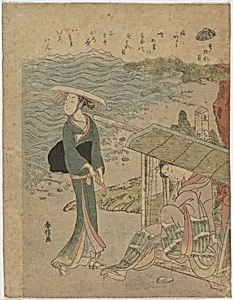
すだれ貝|The Curtain Clam
Medium
Woodblock print; ink and color on paper
Dimensions
H. 11 1/4 in. (28.6 cm); W. 8 9/16 in. (21.7 cm)
Classification
Prints
Culture & Period
Japan · Edo period (1615–1868)
Department
Asian Art
Museum
Metropolitan Museum of Art, New York, NY
Credit
H. O. Havemeyer Collection, Bequest of Mrs. H. O. Havemeyer, 1929
Accession Number
JP1635
Rights
Public Domain
Tags
Art Historical Context
Suzuki Harunobu's *The Curtain Clam* (すだれ貝) is a delightful woodblock print from Japan's Edo period (16151868), capturing thefloating world" (ukiyo-e) essence of everyday beauty and leisure. Harunobu, a pioneering master of the genre, is celebrated for his innovative full-color prints, or *nishiki-e* ("brocade pictures"), which brought vibrant hues to paper through intricate layering of color blocks. This intimate *hosoban* format—measuring just 11¼ × 8⅝ inches—suggests it was designed for personal appreciation, perhaps tucked into a kimono sleeve. The scene likely evokes a playful beachside moment with women, hinted at by its tags, where the title's "curtain clam" (*sudare-gai*) may pun on seashells resembling bamboo blinds (*sudare*), a clever nod to Japanese wordplay and visual wit. Rendered in ink and color on paper, Harunobu's delicate lines and subtle shading highlight feminine grace amid nature's bounty, reflecting Edo society's fascination with urban pleasures and seasonal outings. Housed in the Metropolitan Museum of Art's Asian Art department from the prestigious H.O. Havemeyer Collection, this print exemplifies ukiyo-e's cultural role in democratizing art, making sophisticated imagery accessible beyond elites. Visitors will appreciate its timeless charm, blending sensuality, humor, and technical mastery.
About the Artist
Suzuki Harunobu · 1725–1770
Suzuki Harunobu (c. 1725-1770) was a Japanese ukiyo-e artist who revolutionized woodblock printing by developing nishiki-e—full-color prints using multiple woodblocks—in 1765. Before Harunobu, Japanese prints were limited to two or three colors; his innovation unleashed the entire artist's palette, transforming ukiyo-e into the vibrant art form that would later captivate Western artists from Manet...