
The Dance Class
1874
Medium
Oil on canvas
Dimensions
32 7/8 x 30 3/8 in. (83.5 x 77.2 cm)
Classification
Paintings
Department
European Paintings
Museum
Metropolitan Museum of Art, New York, NY
Credit
Bequest of Mrs. Harry Payne Bingham, 1986
Accession Number
1987.47.1
Rights
Public Domain
Tags
Art Historical Context
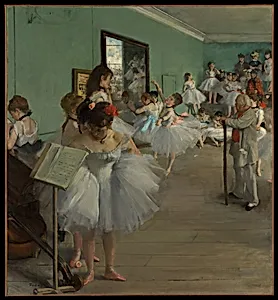
In 1874, Edgar D captured the graceful yet everyday world of Parisian ballet in *The Dance Class*, an oil on canvas that exemplifies his fascination with dancers. This Impressionist masterpiece depicts a group of young female students mid-rehearsal in a sunlit studio, accompanied by a male instructor—likely a ballet master—amid the poised figures of adult women. Painted during the height of the Paris Opéra's prominence, it offers a glimpse into the disciplined training behind the glamour of 19th-century ballet performances, a cultural phenomenon that captivated French society. Degas, a keen observer of modern life, revolutionized composition with unconventional angles and cropped figures, drawing viewers into the intimate, off-kilter space as if peeking through a doorway. His masterful handling of oil paint conveys subtle shifts in light filtering through windows, highlighting the dancers' tutus and musculature with a sense of immediacy and movement. Unlike romanticized ballet scenes, Degas emphasized the labor and hierarchy of the studio, blending realism with Impressionist techniques. Now housed in the Metropolitan Museum of Art's European Paintings department (bequest of Mrs. Harry Payne Bingham, 1986), this 32⅞ × 30⅜-inch work remains a cornerstone of Degas's oeuvre, inviting visitors to appreciate the artistry in ordinary moments. (198 words)
About the Artist
Edgar Degas · 1834–1917
Edgar Degas (1834-1917) stands as one of the most innovative artists of the nineteenth century, whose distinctive vision transformed how modern life could be depicted on canvas. Born Hilaire-Germain-Edgar De Gas in Paris to a wealthy banking family—his father French, his mother a Louisiana Creole from New Orleans—Degas received a classical education before abandoning law studies in 1855 to pursue ...