
The Dance of Death
16th century
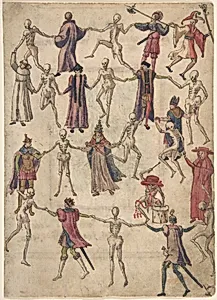
Medium
Pen and brown ink, brush and brown ink, watercolor, gouache, gold paint
Dimensions
7 7/16 × 5 3/8 in. (18.9 × 13.6 cm)
Classification
Drawings
Department
Drawings and Prints
Museum
Metropolitan Museum of Art, New York, NY
Credit
Purchase, Harry G. Sperling Fund, James A. and Maria R. Warth Gift, in memory of Anne and Peter Warth, and Bequest of Clifford A. Furst, by exchange, 1996
Accession Number
1996.70
Rights
Public Domain
Tags
Art Historical Context
In the 16th-century German drawing *The Dance of Death*, an anonymous artist captures the timeless medieval motif of the *Danse Macabre*—a stark allegory where skeletons lead humans in a macabre dance, symbolizing death's impartiality across all social classes. Created amid the Renaissance's fascination with mortality, heightened by recurring plagues and the Reformation's upheavals in Germany, this work reminds viewers that no one escapes the great equalizer. The tags of dancing skeletons and human figures evoke a lively yet eerie procession, blending whimsy with warning. Rendered on a intimate scale (7 7/16 × 5 3/8 in.), the piece employs a rich mixed-media technique: pen and brush in brown ink for precise lines and fluid shading, layered with watercolor, gouache, and gold paint for luminous highlights. This opulent approach, typical of Northern European manuscripts and prints, elevates a simple drawing into a jewel-like object, possibly intended for personal devotion or study. Housed in the Metropolitan Museum of Art's Drawings and Prints department, it exemplifies the era's masterful draftsmanship and enduring cultural meditation on life's fragility.