
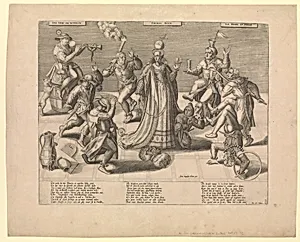
The Dance of the World
mid-16th century
Medium
Engraving; second state
Dimensions
plate: 12 3/4 x 16 in. (32.4 x 40.7 cm) sheet: 16 1/4 x 20 1/16 in. (41.2 x 51 cm)
Classification
Prints
Department
Drawings and Prints
Museum
Metropolitan Museum of Art, New York, NY
Credit
Purchase, Gift of Mrs. Gardner Cassatt, by exchange, 1997
Accession Number
1997.370
Rights
Public Domain
Tags
Art Historical Context
**The Dance of the World is a lively mid-16th-century by Pieter Balten, Flemish artist known for his vibrant depictions of peasant life, festivals, and allegories. Created during the Northern Renaissance, this second-state print—measuring about 12¾ x 16 inches on the plate—captures a chaotic village dance filled with men and women twirling amid musical instruments like lutes and bagpipes, with playful dogs adding to the frenzy. Balten's style blends genre scenes with subtle satire, reflecting the era's fascination with worldly pleasures and folly. Engravings like this were revolutionary for their time, allowing intricate details to be reproduced affordably and widely distributed across Europe. The "second state" indicates refinements to the plate, such as enhanced lines or shading, enhancing its visual punch. As a product of Antwerp's bustling print workshops, it echoes the cultural vibrancy of the Reformation period, where dance motifs often symbolized life's fleeting joys or vanities. Today, housed in the Metropolitan Museum of Art's Drawings and Prints department (acquired in 1997), this work invites visitors to ponder the timeless rhythm of human celebration—and mischief—frozen in copperplate precision.