
The Dancing Girl
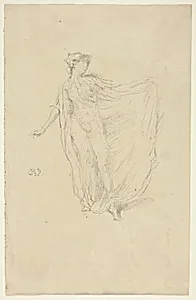
Medium
Transfer lithograph in black on tan laid paper
Dimensions
Image: 18.2 × 14.8 cm (7 3/16 × 5 7/8 in.); Sheet: 31.2 × 20.2 cm (12 5/16 × 8 in.)
Classification
transfer lithograph
Department
Prints and Drawings
Museum
Art Institute of Chicago
Accession Number
139418
Rights
Public Domain
Art Historical Context
James McNeill Whistler’s *The Dancing Girl* (1889) is a delicate transfer lithograph in black ink on tan laid paper, capturing a poised female figure mid-movement. Measuring just 18.2 × 14.8 cm for the image itself, this intimate print exemplifies Whistler’s late-career fascination with printmaking, housed today in the Art Institute of Chicago’s Prints and Drawings Department. Whistler, an American expatriate in London and champion of the Aesthetic movement, prioritized “art for art’s sake,” emphasizing tonal harmony and subtle effects over narrative detail. This work reflects his shift toward lithography in the 1880s, producing over 100 prints that blurred lines between painting and reproduction. Transfer lithography, his preferred technique here, involved drawing on paper then transferring the image to a lithographic stone, yielding soft, painterly lines that mimic etching’s fluidity while allowing editions for wider access. Created during a period of personal and artistic renewal after legal battles like his famous libel suit against critic John Ruskin, *The Dancing Girl* evokes the graceful performers of fin-de-siècle Europe, celebrating ephemeral beauty through economical means. Its modest scale invites close contemplation, revealing Whistler’s mastery in evoking mood with minimal strokes—a testament to printmaking’s democratic potential.
About the Artist
James McNeill Whistler · 1834–1903
James Abbott McNeill Whistler (1834-1903) was an American-born painter and printmaker who became a leading figure in the Aesthetic Movement and pioneer of Tonalism and Japonisme. He revolutionized art by championing "art for art's sake" and treating paintings as visual equivalents of musical compositions, titling works as "arrangements," "harmonies," and "nocturnes" to emphasize formal qualities o...