
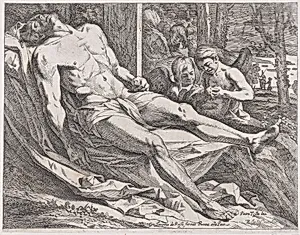
The dead Christ accompanied by angels at right
Medium
Etching
Dimensions
sheet: 7 5/8 x 9 7/8 in. (19.4 x 25.1 cm)
Classification
Prints
Department
Drawings and Prints
Museum
Metropolitan Museum of Art, New York, NY
Credit
The Elisha Whittelsey Collection, The Elisha Whittelsey Fund, 1951
Accession Number
51.501.4252
Rights
Public Domain
Art Historical Context
This intimate etching, created by Pietro Testa (with possible involvement from Giovanni Cesare Test) between 1650 and 165, captures a poignant moment of mourning. The composition centers on the lifeless body of Christ, tenderly attended by angels on the right side of the sheet. Rendered in delicate lines and subtle tonal contrasts typical of the medium, the work invites quiet contemplation of sacrifice and divine compassion. Testa, an Italian artist active during the Baroque era, was renowned for his expressive etchings that blended classical restraint with emotional intensity. In the mid-seventeenth century, such prints played a vital role in spreading religious imagery beyond church walls, allowing private devotion and reflection amid the Counter-Reformation’s emphasis on personal faith. The modest scale—just under eight by ten inches—further suggests it was intended for intimate viewing rather than grand display. As a fine example from the Metropolitan Museum’s collection of prints and drawings, this work highlights the technical mastery of etching, where acid bites into the plate to create fluid, atmospheric effects. Its presence in the Elisha Whittelsey Collection underscores the enduring appeal of Baroque devotional art for modern audiences.
About the Artist
Pietro Testa|Giovanni Cesare Testa · 1612–1650
Pietro Testa was born in Lucca in 1612 and, in accordance with the conventions of Italian artistic training, made his way to Rome while still young. There he studied under two of the leading painters of the early seventeenth century: Domenichino, from whom he absorbed a taste for classical restraint and narrative clarity, and Pietro da Cortona, whose more exuberant Baroque manner offered a contras...