
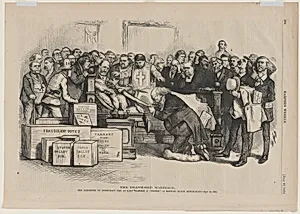
The Death-Bed Marriage
Medium
Classification
Department
Smithsonian Collection
Museum
Smithsonian American Art Museum
Credit
National Portrait Gallery, Smithsonian Institution
Accession Number
S/NPG.76.18
Rights
Public Domain
Tags
Art Historical Context
**The Death-Bed Marriage** a sharp political print created by Thomas Nast in 1872, a master of 19th-century caricature and editorial illustration. Working primarily for *Harper's Weekly*, Nast pioneered the use of wood engravings to sway public opinion through exaggerated portraits and biting satire. This piece, housed in the Smithsonian American Art's collection (with credit to the National Portrait Gallery), exemplifies his style: bold lines, dramatic symbolism, and unflinching commentary on American politics. The artwork depicts Horace Greeley, the famed newspaper publisher, abolitionist, and 1872 presidential candidate, on a hospital bed amid election turmoil. Tags evoke a hospital room scene with a cross suggesting mortality, a ballot box hinting at political maneuvering, and newspapers underscoring Greeley's role as editor of the *New York Tribune*. Nast likely skewers Greeley's controversial alliance with Democrats against Ulysses S. Grant, framing it as a "death-bed marriage"—a desperate, fatal union that doomed his campaign. Greeley died shortly after his electoral defeat in November 1872, adding grim prescience to the satire. Nast's prints like this one shaped public discourse during Reconstruction, amplifying Republican views and influencing voter sentiment. As a medium, these affordable prints reached millions, democratizing political art and cementing Nast's legacy as the "Father of the American Cartoon." A poignant reminder of how images can immortalize fleeting scandals.