
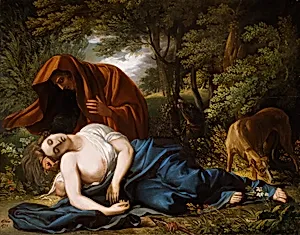
The Death of Procris
1770, retouched 1803
Medium
Oil on panel
Dimensions
32.4 × 41.2 cm (12 3/4 × 16 1/4 in.); Framed: 41.6 × 50.8 × 5.1 cm (16 3/8 × 20 × 2 in.)
Classification
oil on panel
Department
Painting and Sculpture of Europe
Museum
Art Institute of Chicago
Accession Number
57148
Rights
Public Domain
Art Historical Context
In the intimate glow of Benjamin West's *The Death of Procr* (1770, retouched 1803), encounter a poignant moment from classical mythology drawn from Ovid's *Metamorphoses*. The painting captures the tragic instant when Cephalus, mistaking his devoted wife Procris for a wild animal during a hunt, fatally wounds her with his javelin. This small oil on panel (32.4 × 41.2 cm) draws us into the raw emotion of unintended loss, its compact dimensions perfect for contemplation in a museum setting like the Art Institute of Chicago's Department of Painting and Sculpture of Europe. West, a pioneering American-born artist who became a fixture in London's neoclassical scene and second President of the Royal Academy, excelled at blending antiquity with dramatic realism. Painted at the height of the Enlightenment's fascination with classical virtue and pathos, the work reflects neoclassicism's emphasis on moral storytelling through heroic narratives. The choice of oil on panel—a durable, smooth surface favored for detailed studies—allowed West's precise brushwork to shine, while his 1803 retouches likely refined its luminous effects. This gem highlights West's versatility beyond grand history canvases, offering a window into 18th-century tastes for mythic tragedy. Framed elegantly at 41.6 × 50.8 cm, it invites you to ponder the fragility of love amid fate's cruel twists.
About the Artist
Benjamin West · 1738–1820
Benjamin West, born on October 10, 1738, in Springfield, Pennsylvania, emerged as one of the most influential painters of his era despite being entirely self-taught. Growing up in a Quaker family in colonial America, West displayed prodigious talent from childhood, creating portraits and religious scenes with materials gifted by local patrons. By his late teens, he had garnered enough support to t...