
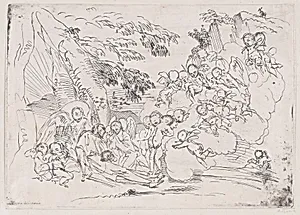
The death of Saint Pellegrino surrounded by many putti
1700–1800
Medium
Etching
Dimensions
plate: 7 5/8 x 10 13/16 in. (19.4 x 27.5 cm) sheet: 7 3/4 x 10 7/8 in. (19.7 x 27.7 cm)
Classification
Prints
Department
Drawings and Prints
Museum
Metropolitan Museum of Art, New York, NY
Credit
The Elisha Whittelsey Collection, The Elisha Whittelsey Fund, 1951
Accession Number
51.501.4416
Rights
Public Domain
Art Historical Context
This 18th-century etching captures the poignant moment of Saint Pellegrino’s death, encircled by a host of putti—cherubic figures that often symbolize divine comfort and the soul’s ascent to heaven. Created between 1700 and 1800, the work reflects the enduring popularity of religious subjects in European printmaking, where scenes of saints’ final moments served both devotional and didactic purposes for a wide audience. The medium of etching allowed artists to achieve fine lines and delicate shading, making it ideal for conveying emotional depth and intricate details like the fluttering wings of the putti. Attributed to Pietro Testa or an anonymous follower, the print carries forward the dramatic sensibilities of Baroque religious imagery into the following century. Housed in the Metropolitan Museum of Art’s Department of Drawings and Prints, this intimate plate—measuring roughly 7⅝ by 10⅞ inches—exemplifies how etchings helped disseminate sacred stories across Europe, blending artistic skill with spiritual narrative.
About the Artist
Pietro Testa|Anonymous, 18th century · 1612–1650
Pietro Testa was born in Lucca in 1612 and, in accordance with the conventions of Italian artistic training, made his way to Rome while still young. There he studied under two of the leading painters of the early seventeenth century: Domenichino, from whom he absorbed a taste for classical restraint and narrative clarity, and Pietro da Cortona, whose more exuberant Baroque manner offered a contras...