
The Death of St. Peter Martyr
1530/35
Medium
Oil on canvas
Dimensions
115.3 × 141 cm (45 5/16 × 55 1/2 in.); Framed: 144.8 × 170.2 × 16.9 cm (57 × 67 × 6 5/8 in.)
Classification
oil on canvas
Department
Painting and Sculpture of Europe
Museum
Art Institute of Chicago
Accession Number
158137
Rights
Public Domain
About this artwork
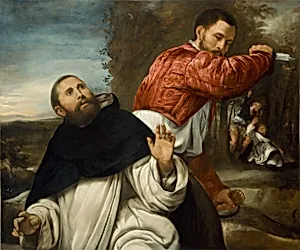
Here, Giovanni Girolamo Savoldo depicted the final moments in the life of Saint Peter Martyr, a 13th-century Dominican friar who was murdered by Cathar heretics whom he wished to reconvert to Catholicism. By choosing a three-quarter-length format, Savoldo focused attention on the contrasting emotional states of the serenely resigned saint and his elegantly brutish assailant. Savoldo lived in Venice but had ties to the city of Brescia in nearby Lombardy. He created a darkly poetic style by inves...
Art Historical Context
Giovanni Girolamo Savoldo’s *The Death of St. Peter Martyr* (1530/35) captures a pivotal moment from the life of the thirteenth-century Dominican friar and inquisitor Peter of Verona, who was by heretics while traveling near Milan. Painted in oil on canvas during the height of the Italian Renaissance, the work reflects Savoldo’s Venetian training and his interest in dramatic religious narratives. The large scale—over four feet high—would have encouraged close viewing, inviting worshippers and visitors to reflect on themes of faith, sacrifice, and divine justice. Savoldo, active in both Brescia and Venice, was admired for his sensitive handling of light and texture. In this canvas, the oil medium allowed him to create luminous effects and subtle gradations of shadow that heighten the emotional intensity of the scene. The painting’s placement in the Art Institute of Chicago’s European collection today underscores its enduring value as both a devotional image and a masterful example of sixteenth-century Lombard-Venetian painting. Visitors often notice how Savoldo balances the violence of the martyrdom with a sense of spiritual calm, a hallmark of his approach to sacred subjects. The work stands as a vivid reminder of the turbulent religious climate of Renaissance Italy and the power of art to convey both human drama and divine purpose.