
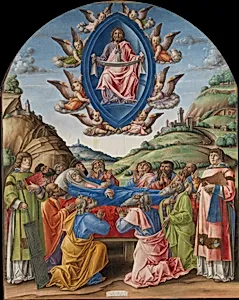
The Death of the Virgin
Medium
Tempera on wood
Dimensions
Arched top, 74 3/4 x 59 in. (189.9 x 149.9 cm)
Classification
Paintings
Department
European Paintings
Museum
Metropolitan Museum of Art, New York, NY
Credit
Gift of Robert Lehman, 1950
Accession Number
50.229.1
Rights
Public Domain
Tags
Art Historical Context
Bartolomeo Vivarini's *The Death of the Virgin (1484) is a poignant late-15th-century masterpiece in tempera on wood, measuring an impressive 74 3/4 x 59 inches with an arched top that hints at its original role in a Venetian church altarpiece. Vivarini, a prominent painter from Venice's influential Vivarini workshop, captures the solemn moment of the Virgin Mary's death—or Dormition—surrounded by mourning apostles, angels, and Christ receiving her soul. This scene, a staple of Christian iconography, reflects the era's deep devotion to Marian themes, blending spiritual tenderness with Renaissance humanism. Painted in egg tempera, a meticulous technique mixing pigment with egg yolk for vibrant, jewel-like colors and fine detail, the work exemplifies Venetian early Renaissance style. The luminous figures and architectural backdrop evoke the city's Byzantine-influenced grandeur, while Vivarini's precise modeling brings emotional depth to the apostles' grief and the heavenly host above. Donated to the Metropolitan Museum of Art in 1950 by Robert Lehman, this painting offers visitors a window into 15th-century Italy's rich religious art, where faith and artistry intertwined to inspire awe.