
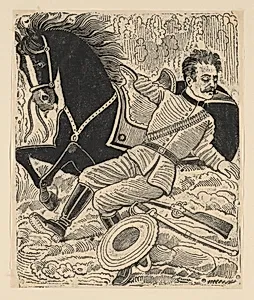
The death of Zapata who has fallen from his horse
ca. 1910
Medium
Zincograph
Dimensions
Sheet: 7 1/16 × 5 7/8 in. (18 × 15 cm)
Classification
Prints
Department
Drawings and Prints
Museum
Metropolitan Museum of Art, New York, NY
Credit
Gift of Jean Charlot, 1930
Accession Number
30.82.10
Rights
Public Domain
Tags
Art Historical Context
José Guadalupe Posada's *The Death of Zapata Who Has Fallen from His Horse (ca. 1910) captures a pivotal moment in Mexico's turbulent revolutionary era. Printed as a zincograph—a relief printing technique on zinc plates that enabled affordable, widespread distribution— this small yet dramatic work (7 1/16 × 5 7/8 in.) depicts Emiliano Zapata, the leader of the southern revolutionary forces, tumbling from his horse amid soldiers, weapons, and the specter of death. Posada, a master of Mexican popular graphics, often used such broadsheets to comment on politics, mortality, and social upheaval during the Mexican Revolution (1910–1920). Zapata championed agrarian reform with his famous cry "Tierra y Libertad" (Land and Liberty), making him a folk hero whose 1919 assassination this print foreshadows or dramatizes. Posada's stark, bold lines and satirical edge reflect his signature style, blending indigenous folk art with biting social critique, much like his iconic calaveras (skeletons). This zincograph exemplifies how printmaking democratized art, reaching everyday audiences through newspapers and flyers. Housed in the Metropolitan Museum of Art's Drawings and Prints department (gift of Jean Charlot, 1930), the piece underscores Posada's enduring influence on Mexican visual culture, inspiring later artists like Diego Rivera and symbolizing the Revolution's human cost. A poignant reminder of heroism and tragedy.
About the Artist
José Guadalupe Posada · 1852–1913
José Guadalupe Posada (1852-1913) was a Mexican printmaker and engraver who revolutionized popular art and created some of the most iconic images in Mexican culture. Working primarily with publisher Antonio Vanegas Arroyo, he produced over 20,000 images during his career—inexpensive broadsheets sold for a penny on colored paper that made his art accessible to even the poorest workers. He transform...