
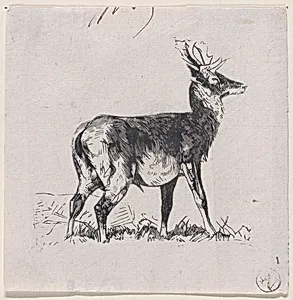
The Deer
ca. 1853
Medium
Wood engraving
Dimensions
Sheet: 2 15/16 × 2 15/16 in. (7.5 × 7.5 cm)
Classification
Prints
Department
Drawings and Prints
Museum
Metropolitan Museum of Art, New York, NY
Credit
Gift of Howard Mansfield, 1927
Accession Number
27.69.4
Rights
Public Domain
Tags
Art Historical Context
**The Deer**, a delicate wood engraving by French artist Charles Jacque from around 1853, captures the quiet grace of a solitary deer in a compact square format measuring just under 3 inches on each side. Housed in the Metropolitan Museum of Art's Drawings and Prints department, this print was a generous gift from collector Howard Mansfield in 192. Jacque, a key figure in the Barbizon school, specialized in pastoral scenes and animal subjects, blending Realism with a romantic appreciation for nature. Wood engraving, the medium here, was a 19th-century innovation prized for its precision. By carving fine lines into the end-grain of hardwood blocks, artists like Jacque achieved intricate details suitable for book illustrations and affordable reproductions—perfect for this intimate scale. His technique highlights the deer's textured fur and alert posture, evoking the wild serenity of French countryside woodlands during the Romantic era. This artwork reflects mid-19th-century fascination with the natural world amid industrialization, inviting viewers to pause and admire wildlife's subtle beauty. A charming gem for print enthusiasts, it showcases Jacque's skill in transforming humble wood into evocative poetry. (178 words)
About the Artist
Charles Jacque · 1813–1894
Charles-Émile Jacque (1813–1894) was a pioneering French painter, engraver, and illustrator whose career bridged the worlds of printmaking and pastoral painting. Born in Paris amid a difficult childhood, he apprenticed at age seventeen to a map engraver, mastering drypoint technique and producing his first etching in 1830—a copy of a head after Rembrandt. After serving seven years in the French Ar...