
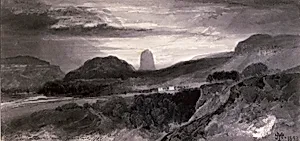
The Devil's Tower from Johnstons
1893
Medium
Drawing
Classification
Drawing
Department
Smithsonian Collection
Museum
Smithsonian American Art Museum
Credit
Smithsonian American Art Museum, Bequest of John Holmes Maghee
Accession Number
1938.12.1
Rights
Public Domain
Tags
Art Historical Context
Thomas Moran's *The Devil's Tower from Johnstons*, created in 1893, captures the dramatic silhouette of Wyoming's Devil's Tower—a striking igneous rock formation rising over 800 feet from the plains—as viewed from Johnstons Creek. A master of the Hudson River School, Moran was renowned for his luminous landscapes that romanticized the American West, often drawing from his expeditions with government surveys in the 1870s and beyond. This drawing reflects his lifelong fascination with the rugged beauty of sites like Yellowstone, blending scientific observation with poetic grandeur. As a preparatory drawing in ink or graphite (typical of Moran's sketches), it showcases his skillful use of line and shading to convey monumental scale and atmospheric depth, techniques honed during his travels. Devil's Tower, long sacred to Native American tribes like the Lakota and Kiowa for its spiritual significance, was later designated America's first national monument in 1906 by President Theodore Roosevelt—highlighting the era's growing appreciation for natural wonders amid westward expansion. Housed in the Smithsonian American Art Museum through the bequest of John Holmes Maghee, this work invites visitors to ponder the interplay of geology, culture, and artistry in shaping our national identity. Though sometimes misidentified as a volcano in early accounts, its true origins as an ancient laccolith add to its allure as a testament to time's sculpting power.
About the Artist
Thomas Moran · 1837–1926
Thomas Moran (1837–1926) was an American painter and printmaker of the Hudson River School whose dramatic paintings of the American West played a pivotal role in the creation of the national parks. Born in Bolton, Lancashire, England, he emigrated with his family to Philadelphia as a child. He was largely self-taught, though he apprenticed briefly with a wood engraver and studied the work of J.M.W...