
The Discovery
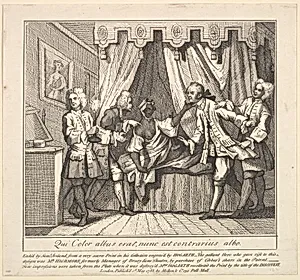
Medium
Etching and engraving; second state of three
Dimensions
sheet: 7 13/16 x 8 7/16 in. (19.8 x 21.5 cm)
Classification
Prints
Department
Drawings and Prints
Museum
Metropolitan Museum of Art, New York, NY
Credit
Harris Brisbane Dick Fund, 1932
Accession Number
32.35(240)
Rights
Public Domain
Tags
Art Historical Context
"The Discovery," created in 1788, is an etching and engraving that reflects the enduring influence of William Hogarth’s satirical style, even decades after his death. Attributed in part to Samuel Ireland and produced by Molton and Co., this second-state print captures a lively bedroom scene populated by and women gathered around a bed. Measuring just under eight inches across, the compact format was typical of affordable prints meant for wide circulation among 18th-century audiences. Hogarth’s narrative approach often used domestic interiors to comment on social manners and moral dilemmas, and this work continues that tradition. The medium of etching and engraving allowed fine detail and multiple impressions, making such images accessible beyond elite collectors. As part of the Metropolitan Museum’s collection of prints, it offers modern viewers a glimpse into Georgian-era storytelling through visual satire. Acquired through the Harris Brisbane Dick Fund in 1932, the print exemplifies how reproductive techniques preserved and popularized Hogarth’s sharp observations of human behavior for later generations.
About the Artist
Molton and Co.|Samuel Ireland|William Hogarth (British|British|British) · 1750 |1700 |1697 –1850 |1800 |1764
London|British, active from ca. 1760, died London 1800|British, London 1697–1764 London