
The Discovery of the True Cross
1581–1644
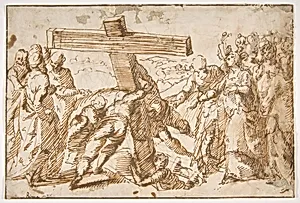
Medium
Pen and brown ink, over traces of leadpoint or black chalk, on off-white laid paper; framing lines in pen and darker brown ink
Dimensions
7 1/2 x 11 3/16in. (19.1 x 28.4cm)
Classification
Drawings
Department
Drawings and Prints
Museum
Metropolitan Museum of Art, New York, NY
Credit
Purchase, Gifts from Mrs. Gardner Cassatt, Mrs. Francis Ormond, Bessie Potter Vonnoh, William Benton, Donald Silve, William M. Ivins Jr., and Mrs. Harry Payne Whitney, and other gifts, bequests, and funds, by exchange, 1998
Accession Number
1998.255
Rights
Public Domain
Tags
Art Historical Context
Bernardo Strozzi, a prominent Genoese Baroque artist active in the early 17th century (15811644), captures a pivotal moment in Christian legend with *The Discovery of the True Cross*. intricate drawing depicts the biblical story of Saint Helena, mother of Emperor Constantine, unearthing the True Cross amid a bustling crowd. Strozzi's dynamic composition reflects the theatrical energy of the Baroque era, emphasizing religious fervor through clustered figures and the central symbol of the Cross—a motif evoking triumph and devotion during the Counter-Reformation. Executed in pen and brown ink over subtle traces of leadpoint or black chalk on off-white laid paper, the work showcases Strozzi's mastery of preparatory drawing. Measuring 7 1/2 x 11 3/16 inches, it features precise framing lines, suggesting it served as a study for a larger painting. Such techniques allowed artists like Strozzi, influenced by Caravaggio's tenebrism and Rubens's exuberance, to refine gestures and compositions before committing to canvas, blending fluidity with monumental scale. Acquired by the Metropolitan Museum of Art in 1998 through generous gifts and exchanges, this rare sheet offers visitors a window into 17th-century artistic process and the enduring cultural power of relics in Catholic iconography. Its lively crowd scene invites reflection on faith's communal drama.
About the Artist
Bernardo Strozzi · 1581–1644
Strozzi was one of the most influential painters in Italy during the early 17th century, particularly in Genoa and Venice. His powerful and painterly religious works, genre scenes, and portraits are distinguished by their rich, glowing color and broad, energetic brushstrokes. Comment on works: Still Life; Religious; Portraits