
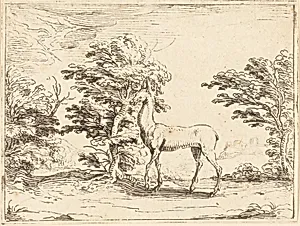
The Doe
1628
Medium
etching on laid paper
Dimensions
sheet (trimmed to plate mark): 6.2 × 8.2 cm (2 7/16 × 3 1/4 in.)
Classification
Department
CG-E
Museum
National Gallery of Art, Washington, D.C.
Credit
Rosenwald Collection
Accession Number
1949.5.448
Rights
Public Domain
Art Historical Context
**The Doe**, a delicate etching by the renowned French printmaker Jacques Callot, dates to 1628 and captures the graceful form of a deer in a compact sheet measuring just 6.2 × 8.2 cm. Created on laid paper, this intimate work exemplifies Callot's prowess during the Baroque era, when he was at the height of his career in Nancy and Florence. Callot, a master innovator in printmaking, often produced such small-scale etchings that allowed for widespread dissemination of his intricate designs, blending meticulous detail with dynamic energy. Etching, Callot's preferred medium, involved coating a copper plate with acid-resistant ground, scratching lines into it, and immersing it in acid to "bite" the grooves—yielding the fine, expressive lines that define *The Doe*. This technique enabled remarkable precision in rendering fur, musculature, and poised movement, making his animal studies both scientific and poetic. Produced amid Europe's tumultuous Thirty Years' War, Callot's works like this one offered a serene counterpoint to his more famous war scenes, highlighting nature's quiet beauty. Housed in the National Gallery of Art's Rosenwald Collection, *The Doe* invites visitors to marvel at 17th-century printmaking's technical brilliance. Its trimmed size suggests it was treasured as a portable gem, perfect for collectors— a testament to Callot's enduring influence on graphic arts.
About the Artist
Jacques Callot · 1592–1635
Jacques Callot (1592–1635) was a French printmaker and draftsman from the Duchy of Lorraine, widely regarded as one of the first great artists to practice the graphic arts exclusively. His more than 1,400 etchings chronicled the breadth of 17th-century life, from Medici court festivities to the brutal realities of warfare. Callot revolutionized etching through technical innovations including the é...