
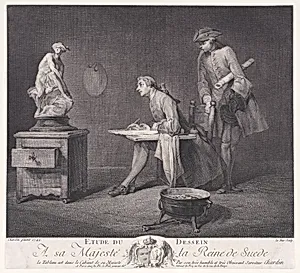
The Drawing Lesson
Medium
Etching, engraving; second state
Dimensions
Sheet: 11 1/4 × 12 1/4 in. (28.5 × 31.1 cm)
Classification
Prints
Department
Drawings and Prints
Museum
Metropolitan Museum of Art, New York, NY
Credit
Harris Brisbane Dick Fund, 1953
Accession Number
53.600.535
Rights
Public Domain
Tags
Art Historical Context
The Drawing captures a quiet moment of artistic, rendered as an etching and engraving after an original painting by Jean Siméon Chardin. Created between 1749 and 1783 by Jacques Philippe Le Bas in its second state, this print measures just over eleven by twelve inches and belongs to the Metropolitan Museum of Art’s collection of works on paper. Chardin, a leading French artist of the eighteenth century, was celebrated his sensitive depictions of everyday life rather than grand historical subjects, favoring intimate genre scenes that reveal the dignity of ordinary activities. The composition centers on the act of from a sculptural model, highlighting the educational practices of the period when aspiring artists trained through careful observation and replication. Le Bas’s engraving technique skillfully translates Chardin’s subtle tonal effects and textures into lines that could be widely circulated, allowing viewers beyond elite circles to appreciate the scene. The presence of both teacher and student underscores themes of and skill-building central to Enlightenment-era art education. As a print, the work how reproductive media extended the reach of Chardin’s domestic subjects, blending technical precision with warm human observation. Its modest scale invites close looking, rewarding viewers with details of tools, gestures, and concentration that reflect the patient craft of both drawing and printmaking.
About the Artist
Jean Siméon Chardin|Jacques Philippe Le Bas|Jacques Philippe Le Bas · 1699–1779
Jean-Baptiste-Siméon Chardin, born on November 2, 1699, in Paris to a cabinetmaker father who crafted billiard tables, grew up immersed in the city's artisan world on the Left Bank near Saint-Sulpice. His early training came through apprenticeships with the history painters Pierre-Jacques Cazes, where he honed academic drawing techniques, and Noël-Nicolas Coypel, whose assignment to copy a musket ...