
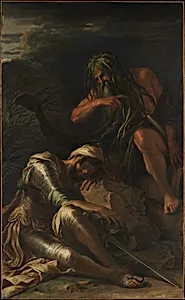
The Dream of Aeneas
1660–65
Medium
Oil on canvas
Dimensions
77 1/2 x 47 1/2 in. (196.9 x 120.7 cm)
Classification
Paintings
Department
European Paintings
Museum
Metropolitan Museum of Art, New York, NY
Credit
Rogers Fund, 1965
Accession Number
65.118
Rights
Public Domain
Tags
Art Historical Context
In the grand tradition of Baroque history painting, Salvator Rosa's *The Dream of Aeneas* (1660–65) captures a pivotal moment from Virgil's epic *Aeneid*. The Neapolitan artist depicts the Trojan hero Aeneas asleep, likely visited in a dream by the ghost of Hector urging him to flee the burning city of Troy. This scene, rich with swords and armored men, embodies the poem's themes of destiny, loss, and the founding of Rome, resonating in 17th-century Europe amid fascination with classical antiquity. Rosa, a rebellious figure known for his dramatic tenebrism—harsh contrasts of light and shadow inherited from Caravaggio—infuses the large-scale oil on canvas (nearly 78 x 47 inches) with intense emotion and movement. His rugged style, blending history with landscape elements, elevates the mythological narrative into a visceral human drama, showcasing his mastery of chiaroscuro to heighten the dream's otherworldly tension. Acquired by The Metropolitan Museum of Art through the Rogers Fund in 1965, this work highlights Rosa's influence on later Romantic artists, bridging Baroque grandeur with proto-Romantic individualism. Visitors will appreciate its timeless exploration of fate's call amid slumber.
About the Artist
Salvator Rosa · 1615–1673
Salvator Rosa was born in 1615 in Arenella, on the outskirts of Naples, into a world of artistic ambition and turbulent talent. His early training came through his maternal uncle, the painter Paolo Greco, and his brother-in-law Francesco Fracanzano, himself a pupil of the great Spanish-born Neapolitan master Jusepe de Ribera. Rosa showed a fierce independence from the start, resisting his father's...