
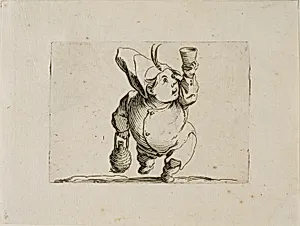
The Drinker Seen from the Front, from Varie Figure Gobbi
1616
Medium
Etching on paper
Dimensions
Image/plate: 6.1 × 8.5 cm (2 7/16 × 3 3/8 in.); Sheet: 9.7 × 12.9 cm (3 7/8 × 5 1/8 in.)
Classification
etching
Department
Prints and Drawings
Museum
Art Institute of Chicago
Accession Number
128640
Rights
Public Domain
Art Historical Context
Jacques Callot's *The Drinker Seen from Front*, created in 1616, is a captivating etching from his renowned series *Varie Figurebi* (Various Hback Figures). Working in Florence under Medici patronage, the French-born artist produced this set of 21 prints depicting grotesque, contorted hunchbacked figures—likely inspired by Italian carnival performers or court dwarfs. This intimate image, measuring just 6.1 × 8.5 cm, captures a merry drinker in a dynamic frontal pose, mug raised in exuberant toast, blending humor with keen observation of human form. Etching on paper was Callot's specialty, and here he showcases his technical brilliance. Using a fine needle to incise intricate lines into a wax-covered copper plate, he achieved extraordinary detail and texture in such a tiny format, revolutionizing printmaking with his precise, expressive style influenced by Mannerism. The sheet's larger margins (9.7 × 12.9 cm) highlight the plate's purity, making these affordable prints popular across Europe. Housed in the Art Institute of Chicago's Prints and Drawings Department, this work exemplifies early 17th-century graphic artistry. Callot's gobbi series not only entertained but also explored social satire and the grotesque, offering museum visitors a window into Baroque-era wit and the era's fascination with the unconventional human body.
About the Artist
Jacques Callot · 1592–1635
Jacques Callot (1592–1635) was a French printmaker and draftsman from the Duchy of Lorraine, widely regarded as one of the first great artists to practice the graphic arts exclusively. His more than 1,400 etchings chronicled the breadth of 17th-century life, from Medici court festivities to the brutal realities of warfare. Callot revolutionized etching through technical innovations including the é...