
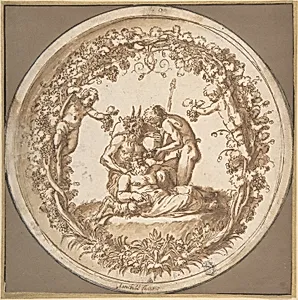
The Drunken SiIenus: Design for the "Tazza Farnese"
Annibale Carracci, 1599–1600
About this artwork
Annibale Carracci's *The Drunken Silenus Design for the "T Farnese"* (1599–1600) captures the exuberant spirit of classical mythology in a masterful preparatory drawing. Depicting the mythological figure Silenus—Dionysus's merry, inebriated companion—the work replicates the famous ancient Roman cameo known as the Tazza Farn, a treasure of the Farnese family collection. Carracci, a leading Bolognese artist and pioneer of the Baroque style, created this during his transformative work on the Farnese Gallery frescoes in Rome, blending Renaissance naturalism with classical antiquity to revitalize artistic expression. Executed on a precise square sheet (10 1/16 x 10 1/16 in.), the drawing employs pen and brown ink, brush and brown wash over black chalk traces, with stylus compass constructions for geometric accuracy—techniques that highlight Carracci's meticulous draftsmanship. These methods allowed him to study and adapt the cameo's intricate relief, emphasizing Silenus's voluptuous male nude form in dynamic, lifelike pose. Such drawings were vital in Carracci's studio practice, bridging ancient artifacts with modern frescoes and influencing generations of artists. This piece exemplifies the Carracci family's revival of disegno (drawing) as a foundation of painting, inviting visitors to appreciate how 16th-century masters like Annibale drew inspiration from antiquity to infuse Baroque art with vitality and humanism. A gem of the Metropolitan Museum of Art's Drawings and Prints collection, it reveals the creative dialogue between past and present.