
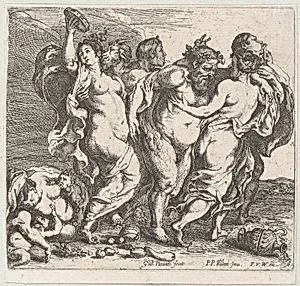
The drunken Silenus, accompanied by nymphs and satyrs
Medium
Etching; second state of two
Dimensions
Plate: 5 1/2 × 6 in. (14 × 15.2 cm) Sheet (Trimmed): 5 13/16 in. × 6 in. (14.7 × 15.3 cm)
Classification
Prints
Department
Drawings and Prints
Museum
Metropolitan Museum of Art, New York, NY
Credit
The Elisha Whittelsey Collection, The Elisha Whittelsey Fund, 1951
Accession Number
51.501.7668
Rights
Public Domain
Tags
Art Historical Context
Behold *The Drunken Silenus, Accompanied by Nymphs and Satyrs* (1632), a lively etching from the Metropolitan Museum of Art's Drawings and Prints collection. This collaborative masterpiece credits Peter Paul Rubens, the Flemish Baroque titan known for his exuberant mythological scenes, alongside etchers Willem Panneels and Frans van den Wyngaerde. Depicting the inebriated Silenus—Dionysus's boisterous companion—frolicking amid playful nymphs and satyrs, it captures the chaotic joy of Bacchic revelry in a compact plate of just 5½ × 6 inches. As a second-state etching, this print represents a refined stage of the reproductive process, where Rubens's dynamic designs were translated into intricate lines via acid-bitten metal plates. Etchings like this allowed the master's sensual, fleshy figures and swirling compositions to reach collectors across Europe, democratizing Baroque grandeur. The trimmed sheet hints at its intimate scale, perfect for private cabinets of curiosities. Rooted in classical mythology, the scene celebrates themes of excess and abandon, echoing Rubens's fascination with antiquity during his 1630s peak as a court painter and diplomat. Acquired through The Elisha Whittelsey Fund in 1951, it invites visitors to revel in 17th-century printmaking's technical wizardry and timeless hedonism.