
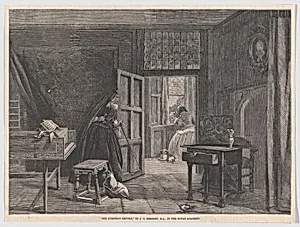
The Duenna's Return, from "Illustrated London News"
May 19, 1860
Medium
Wood engraving
Dimensions
Image: 7 5/8 × 10 1/2 in. (19.3 × 26.7 cm) Sheet: 8 1/16 × 10 3/4 in. (20.4 × 27.3 cm)
Classification
Prints
Department
Drawings and Prints
Museum
Metropolitan Museum of Art, New York, NY
Credit
Gift of Donato Esposito, 2015
Accession Number
2015.653.6
Rights
Public Domain
Tags
Art Historical Context
"The Duenna's Return," published in the Illustrated London News on May 19, 1860, captures a lively Victorian interior scene featuring women, a watchful dog, and musical instruments. Designed by genre painter John Callcott Horsley and engraved on wood by William Luson Thomas, the print depicts the moment a stern chaperone re-enters a domestic space, likely interrupting a flirtatious or musical interlude among younger figures. Horsley’s anecdotal style, rooted in mid-Victorian narrative painting, translates effectively into the crisp lines of wood engraving, inviting viewers to imagine the story’s outcome. Wood engraving was the dominant reproductive technique of the period, allowing intricate detail to be printed rapidly for mass circulation. The Illustrated London News, Britain’s first illustrated weekly, used such images to bring contemporary manners and social comedy into middle-class homes. This particular sheet, gifted to the Metropolitan Museum in 2015, preserves a snapshot of 1860s taste—combining gentle humor with the era’s fascination for domestic drama and musical accomplishment. The work reflects broader cultural interests in propriety, courtship, and the role of the duenna as both guardian and comic foil. Its modest scale and newspaper origins remind us how widely such prints shaped public ideas about art and society in the Victorian age.
About the Artist
William Luson Thomas|John Callcott Horsley (British|British) · 1834 |1830 –1928 |1900
British, London 1834–1928 The Hague|British, London 1830–1900 Chertsey, Surrey