
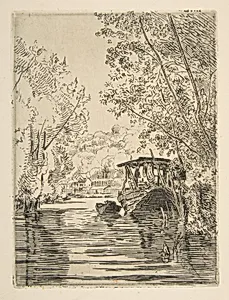
The Dyer's Boat (Bas-Meudon)
ca. 1868
Medium
Etching; first state of two
Dimensions
Sheet: 12 1/8 × 8 7/16 in. (30.8 × 21.4 cm) Plate: 6 1/4 × 4 11/16 in. (15.9 × 11.9 cm)
Classification
Prints
Department
Drawings and Prints
Museum
Metropolitan Museum of Art, New York, NY
Credit
Gift of David Keppel, 1922
Accession Number
22.1.17
Rights
Public Domain
Tags
Art Historical Context
Félix Bracquem's *The Dyer's Boat (Basudon)*, created around 1868, is a etching capturing a slice of everyday life along the Seine River near Meudon, a suburb west of Paris. Bracquemond (1833–1914), a leading French printmaker, was instrumental in the 19th-century revival of etching, drawing inspiration from Japanese woodcuts for his precise yet atmospheric lines. This first state of two impressions—before any revisions—offers a rare glimpse into the artist's initial vision, with subtle tonal variations achieved through acid-bitten lines on a copper plate. The image centers on a dyer's boat, likely used for immersing fabrics in river waters during the dyeing process, evoking the industrious rhythm of Second Empire France. Amid the boats and flowing river, Bracquemond masterfully balances intricate detail with open space, highlighting etching's potential for nuanced light and texture. At just 6¼ × 4⅝ inches, the plate's intimacy invites close viewing, much like a sketchbook page come to life. This work exemplifies Bracquemond's role in elevating printmaking as fine art, bridging Realism's fidelity to nature with emerging Impressionist interests in fleeting effects. A gift to the Metropolitan Museum of Art in 1922, it reminds us how 19th-century artists transformed ordinary river scenes into poetic celebrations of labor and landscape.
About the Artist
Félix Bracquemond · 1833–1914
French, Paris 1833–1914 Sèvres