
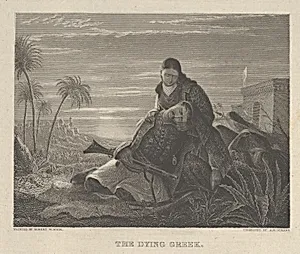
The Dying Greek
Medium
Engraving
Dimensions
plate: 5 15/16 x 7 3/4 in. (15.1 x 19.7 cm) sheet: 9 1/8 x 11 13/16 in. (23.2 x 30 cm)
Classification
Prints
Department
Drawings and Prints
Museum
Metropolitan Museum of Art, New York, NY
Credit
Gift of Mrs. Frederic F. Durand, 1930
Accession Number
30.15.54
Rights
Public Domain
Tags
Art Historical Context
In the early 19th century, news of the Greek War of (1821–1830) stirred sympathy in America, artists like Asher B. Durand and Robert Walter captured its drama in works such as *The Dying Greek* (ca. 1830). This poignant engraving, credited to both luminaries of the American art scene—Durand, a master engraver and River School founder, and Weir, a historical painter—depicts a fallen Greek fighter amid firearms, grieving women, and the shadow of death. Likely inspired by Philhellenic fervor, it reflects Romantic ideals of heroism and sacrifice against Ottoman oppression, resonating with transatlantic support for Greek liberty. Crafted as an intaglio engraving on a modest plate (5 15/16 x 7 3/4 in.), the print's fine lines and tonal depth allowed for detailed emotional expression, making it accessible for wider audiences through reproduction. Donated to the Metropolitan Museum of Art in 1930 by Mrs. Frederic F. Durand, it exemplifies early American printmaking's role in disseminating stirring narratives. Visitors will appreciate how this intimate scene distills the era's blend of classical reverence and modern tragedy into a timeless emblem of human struggle.
About the Artist
Asher Brown Durand|Robert Walter Weir · 1796–1886
Was a principal member of the Hudson River School. American artist; associated with the Hudson River School of landscape painting. Comment on works: Portraits