
The Edge of the Desert
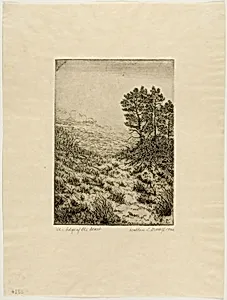
Medium
Etching on cream wove paper
Dimensions
Image/plate: 17.4 × 12.5 cm (6 7/8 × 4 15/16 in.); Sheet: 30.9 × 23.4 cm (12 3/16 × 9 1/4 in.)
Classification
etching
Department
Prints and Drawings
Museum
Art Institute of Chicago
Accession Number
93608
Rights
Public Domain
Art Historical Context
**The Edge of the Desert** *Wallace L. DeWolf, 1920* *Etching on cream wove paper* *Image/plate: 17.4 × 12.5 cm; Sheet: 30.9 × 23.4 cm* *Art Institute of Chicago, Prints and Drawings Department* Step into the vast, sun-bleached expanses evoked by Wallace L. DeWolf's *The Edge of the Desert* (1920), a captivating etching housed in the Art Institute of Chicago's Prints and Drawings collection. Created in the early post-World War I era, this intimate print (just under 7 by 5 inches) draws viewers to the threshold of arid wilderness, where subtle lines suggest shifting sands and distant horizons. DeWolf, an American artist active in the burgeoning print revival of the time, masterfully conveys atmosphere through economical mark-making, inviting contemplation of nature's quiet drama. Etching's allure lies in its precision: DeWolf incised lines into a metal plate, allowing acid to bite delicate grooves that hold ink for printing onto creamy wove paper. This intaglio technique, popular among early 20th-century artists, enabled rich tonal contrasts and textures—from velvety shadows to crisp edges—making fine art accessible beyond paintings. The modest sheet size (about 12 by 9 inches) underscores etching's role in democratizing intricate landscapes for collectors and enthusiasts. As a classified etching, this work highlights the technical innovation and exploratory spirit of 1920s printmaking, preserving DeWolf's vision of boundary-pushing scenery for generations of museum visitors.