
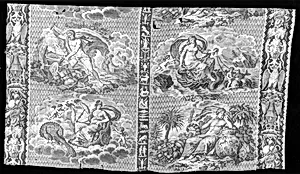
The Elements (Furnishing Fabric)
1810/20
Medium
Cotton, plain weave; copperplate printed
Dimensions
58.1 × 94.4 cm (22 7/8 × 37 1/8 in.)
Classification
textile
Department
Textiles
Museum
Art Institute of Chicago
Accession Number
61724
Rights
Public Domain
Art Historical Context
Created in France around 1810–1820, *The Elements* is a finely detailed furnishing fabric designed by Bonaventure M. Lebert. Woven in cotton plain weave and printed with copperplates, the textile was intended for curtains, upholstery, or wall hangings in fashionable European homes. Its title suggests an allegorical theme popular at the time, likely depicting symbolic figures or scenes representing earth, air, fire, and water. Copperplate printing, a technique refined in the late eighteenth century, allowed designers to achieve remarkably intricate patterns and large repeats that block printing could not match. The crisp lines and subtle shading visible in this piece demonstrate the method’s precision, giving the fabric a refined, almost engraved appearance suitable for neoclassical interiors. As a product of the Napoleonic and post-Napoleonic era, the fabric reflects the period’s taste for classical motifs and scientific curiosity. Such textiles brought educational and decorative themes into domestic spaces, allowing families to admire both artistic skill and Enlightenment ideas within their own homes.