
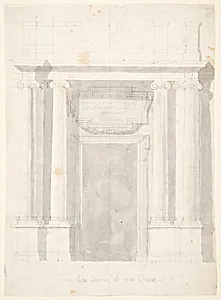
The Elevation of a Church
Medium
architecture
Classification
architecture
Department
Smithsonian Collection
Museum
Smithsonian American Art Museum
Credit
Museum purchase through gift of various donors and from Eleanor G. Hewitt Fund
Accession Number
1938-88-1021
Rights
Public Domain
About this artwork
Research in Progress
Art Historical Context
Giuseppe Valadier, a prominent Italian architect (1762–1839), created *The Elevation of a Church in 1775, when he was just 13 old. This early work his precocious talent during his formative years in Rome, where he under his father, Luigi Valadier, a skilled goldsmith and engraver. As a drawing of a church facade—known as an "elevation" in architectural terms—it represents a flat, scaled projection used by architects to visualize and communicate building designs, bridging the gap between idea and construction. Valadier would go on to become a leading figure in Neoclassicism, a movement that revived the purity and symmetry of ancient Greek and Roman architecture amid the Enlightenment's emphasis on reason and antiquity. Though this piece predates his major projects like the restoration of the Arch of Titus, it hints at his lifelong mastery of precise lines and proportional harmony. Housed in the Smithsonian American Art Museum's architecture collection (museum purchase through various donors and the Eleanor G. Hewitt Fund), it offers a glimpse into 18th-century Italian design education. Today, with research ongoing, *The Elevation of a Church* invites us to appreciate the foundational skills of a young genius whose innovations shaped Rome's urban landscape. A testament to enduring classical ideals, it reminds visitors how architectural drawings once served as blueprints for spiritual and civic monuments.