
The Eleven Ages of Man
1609–72
Medium
Engraving
Dimensions
Sheet: 13 in. × 16 15/16 in. (33 × 43 cm) Plate: 9 15/16 × 14 3/8 in. (25.3 × 36.5 cm)
Classification
Prints
Department
Drawings and Prints
Museum
Metropolitan Museum of Art, New York, NY
Credit
The Elisha Whittelsey Collection, TheElisha Whittelsey fund, 1963
Accession Number
63.601.21
Rights
Public Domain
Tags
Art Historical Context
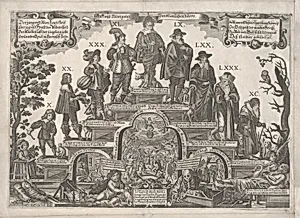
Gerhard Altzenbach’s engraving “The Eleven Ages of Man” presents a detailed visual narrative of human life’s progression. Created in the seventeenth century, the print traces eleven distinct stages from infancy through maturity and into old age, populated by of men, infants, animals, and skeletons. These elements underscore the cyclical and fragile nature of existence, a theme that resonated strongly in early modern Europe. As an engraving, the work highlights the medium’s importance for spreading moral and philosophical ideas. The precise line work allowed Altzenbach to distribute the image widely through prints, reaching audiences beyond elite collectors. The sheet’s modest size—roughly 13 by 17 inches—made it suitable for personal contemplation or display in homes. The inclusion of skeletal motifs evokes memento mori traditions, gently reminding viewers of mortality amid life’s daily concerns. Now part of the Metropolitan Museum of Art’s Drawings and Prints collection, the engraving continues to offer insight into how seventeenth-century artists used allegory to explore the human condition.
About the Artist
Gerhard Altzenbach · 1609–1672
**Gerhard Altzenbach (1609–1672)** was a prominent German engraver, print publisher, and bookseller based in Cologne, where he operated a significant copper-engraving workshop. Active from the early seventeenth century through the 1670s, he specialized in producing and distributing popular devotional prints, city views, calendars, and topical broadsheets that reflected the religious and civic life...