
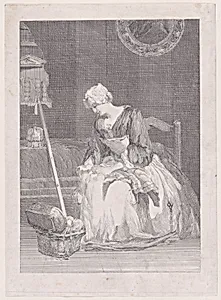
The Embroiderer
Medium
Etching
Dimensions
Sheet (trimmed): 12 in. × 8 3/4 in. (30.5 × 22.2 cm)
Classification
Prints
Department
Drawings and Prints
Museum
Metropolitan Museum of Art, New York, NY
Credit
Myra Carter Church Fund, 1957
Accession Number
57.544.8
Rights
Public Domain
Tags
Art Historical Context
In the intimate etching *The Embroiderer* (1757), Jean Jacques Flipart masterfully reproduces a composition by Jean Siméon Chardin, the celebrated French Rococo painter renowned for his sensitive depictions of everyday domestic life. Chardin's original likely portrays a woman absorbed in needlework, capturing the quiet dignity of ordinary moments—a hallmark of his style that elevated humble activities to poetic heights. Flipart, a skilled engraver, translates this into an etching on a trimmed sheet measuring 12 × 8¾ inches, now housed in the Metropolitan Museum of Art's Drawings and Prints department. Etching, an intaglio technique where acid etches intricate lines into a metal plate, allowed Flipart to convey Chardin's subtle textures, from the soft folds of fabric to the delicate sheen of embroidery threads. This reproductive print played a crucial role in 18th-century France, democratizing access to prestigious artworks by making them affordable for collectors and the emerging middle class. Created amid the Enlightenment's fascination with the domestic sphere, *The Embroiderer* reflects cultural ideals of feminine virtue through needlework, a skill symbolizing patience and refinement. Acquired through the Myra Carter Church Fund in 1957, it invites visitors to appreciate how prints preserved and popularized Chardin's enduring humanism.
About the Artist
Jean Jacques Flipart|Jean Siméon Chardin (French|French) · 1703 |1719 –1770 |1782
French, Paris 1703–1770 Paris|French, 1719–1782