
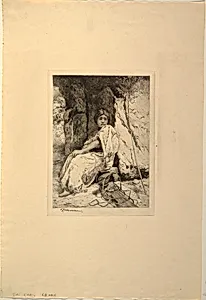
The Empty Cradle
Medium
figures
Classification
figures
Department
Smithsonian Collection
Museum
Smithsonian American Art Museum
Credit
Smithsonian American Art Museum
Accession Number
1948-56-2
Rights
Public Domain
About this artwork
Research in Progress
Art Historical Context
Thomas Moran (1837–1926), a British-born artist who became a cornerstone of American landscape painting, is best known for his luminous depictions of the American West often associated with the Hudson River School In *The Empty Cradle* (1880), Moran shifts focus to the human form, classified here as "figures" within the Smithsonian American Art Museum's collection. during the Gilded Age—a time of rapid industrialization and social change in the United States—this work reflects Moran's versatility beyond his iconic wilderness scenes, exploring intimate, evocative subjects. The title *The Empty Cradle* suggests themes of absence, loss, or quiet domesticity, poignant in an era marked by high infant mortality and family migrations westward. While Moran's signature style emphasized dramatic light and atmospheric effects in oils and watercolors, this piece's classification as "figures" highlights his skill in rendering human emotion and narrative. Housed in the Smithsonian Collection, it invites reflection on personal stories amid national expansion. Currently under research, *The Empty Cradle* remains a tantalizing enigma in Moran's oeuvre, underscoring the ongoing discovery of 19th-century American art. Visitors are encouraged to ponder its emotional resonance in the museum's galleries.