
The Entombment
1830
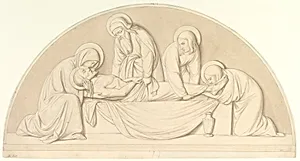
Medium
Pen and brown ink, brown wash, over graphite
Dimensions
sheet: 11 9/16 x 21 15/16 in. (29.4 x 55.7 cm)
Classification
Drawings
Department
Drawings and Prints
Museum
Metropolitan Museum of Art, New York, NY
Credit
Harry G. Sperling Fund, 2010
Accession Number
2010.391
Rights
Public Domain
Tags
Art Historical Context
Philipp Veit's *The Entombment*1830) is a moving preparatory drawing that captures the biblical scene of Christ's body being laid to rest, surrounded by grieving figures including the Virgin Mary, Mary Magdalene, and Saint John the Evangel. Rendered on a large sheet (11 9/16 x 21 15/16 in.), this work exemplifies Veit's devotion to religious themes, drawing from the solemn pathos of Renaissance masters like Raphael and Dürer. a leading member of the Nazarene movement—a group of early 19th-century German artists who rejected neoclassicism in favor of spiritual purity, medieval fresco techniques, and biblical subjects—Veit infused his art with profound emotional depth and moral clarity. Founded in Vienna and later flourishing in Rome, the Nazarenes sought to revive early Christian art, and this drawing reflects that quest through its linear precision and dramatic composition, likely a study for a larger painting or fresco. Executed in pen and brown ink with brown wash over graphite, the medium allows for subtle tonal modeling and fluid contours, highlighting Veit's mastery of light and shadow to evoke tenderness and tragedy. Acquired through the Harry G. Sperling Fund and housed in the Metropolitan Museum of Art's Drawings and Prints department, it offers visitors a window into Romantic-era draftsmanly brilliance and enduring Christian iconography.