
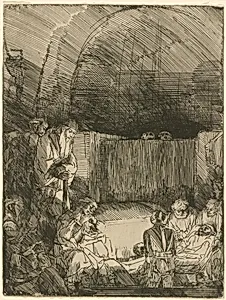
The Entombment
c. 1654
Medium
etching, drypoint and burin
Classification
Department
CG-E
Museum
National Gallery of Art, Washington, D.C.
Credit
Rosenwald Collection
Accession Number
1943.3.7271
Rights
Public Domain
Art Historical Context
In the hushed drama of *The Entombment* (c. 1654), Rembrandt van Rijn one of the Bible's most poignant moments: the lowering of Christ's body into the tomb, surrounded by grieving figures like the Virgin Mary and disciples. Created during Rembrandt's mature Baroque period, this print reflects his profound empathy for human sorrow, using dramatic chiaroscuro—deep shadows pierced by subtle light—to evoke spiritual depth and emotional intimacy. As a Dutch Golden Age master, Rembrandt elevated religious scenes with psychological realism, making the divine feel achingly human. Rembrandt's technical brilliance shines in his innovative use of etching, drypoint, and burin on this copper plate. Etching allowed fluid lines, while drypoint's burr created rich, velvety textures for flesh and fabric; the burin refined details with crisp precision. These intaglio methods produced prints of extraordinary tonal range, rivaling paintings—few impressions survive in pristine "states," making each a treasure. Housed in the National Gallery of Art's Rosenwald Collection (Department CG-E), this work exemplifies Rembrandt's printmaking genius, blending artistry and innovation. Visitors are drawn into its timeless meditation on loss and redemption, a cornerstone of 17th-century European art.
About the Artist
Rembrandt van Rijn · 1606–1669
Rembrandt Harmenszoon van Rijn (1606–1669) stands as one of the greatest visual artists in the history of Western art and the most important Dutch painter of the 17th century. Born in Leiden to a prosperous miller's family, Rembrandt transformed painting through his revolutionary use of light and shadow, his psychological depth in portraiture, and his elevation of etching to a fine art. His approx...