
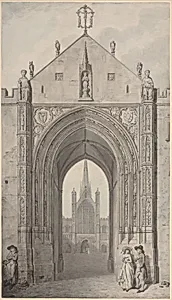
The Erpingham Gate, Norwich
1791
Medium
pen and black ink, gray wash, and watercolor on laid paper
Dimensions
overall: 44.7 x 25.5 cm (17 5/8 x 10 1/16 in.)
Classification
Drawing
Department
CG-E
Museum
National Gallery of Art, Washington, D.C.
Credit
Ailsa Mellon Bruce Fund
Accession Number
1992.48.1
Rights
Public Domain
Art Historical Context
John Carter’s 1791 drawing captures the ornate Erpingham Gate in Norwich with remarkable precision. Created in pen and black ink with delicate gray wash and watercolor, the work exemplifies the refined architectural studies popular among late-eighteenth-century British artists. Carter’s careful layering of translucent washes over fine ink lines brings subtle depth and texture to the medieval stonework, allowing viewers to appreciate both the gate’s intricate carvings and the play of light across its surface. Measuring just under eighteen inches tall, the drawing’s modest scale suits its function as a portable record of historic architecture. The use of laid paper and the combination of media reflect the period’s growing interest in antiquarian documentation, when artists traveled to preserve images of England’s Gothic heritage. Acquired by the National Gallery of Art through the Ailsa Mellon Bruce Fund, this sheet offers today’s visitors an intimate glimpse into both the medieval structure and the artistic techniques that celebrated it two centuries ago.
About the Artist
John Carter · 1748–1817
John Carter RA, born in 1942 in Hampton Hill, Middlesex, emerged as a pivotal figure in British abstract art through his innovative sculptures. He began his formal training at Twickenham School of Art from 1958 to 1959, followed by Kingston School of Art from 1959 to 1963, where he studied under the influential painter Terry Frost. A Leverhulme Travelling Scholarship then took him to Italy, enabli...